
How Jumping Spiders See: Eight Eyes with Different Jobs
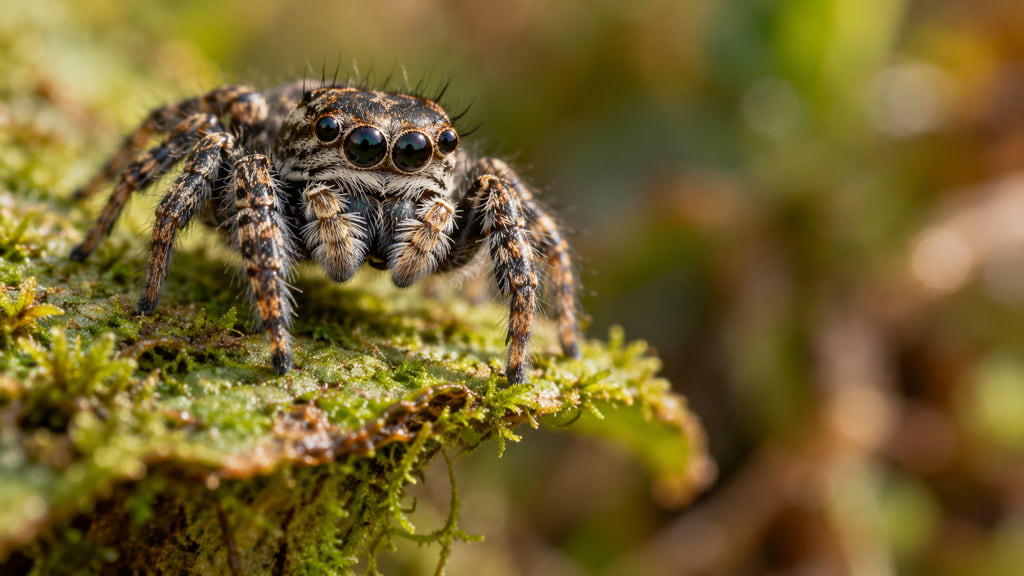
Jumping spiders see with eight eyes that divide the work: the large principal eyes examine fine detail, while secondary eyes help detect movement across a wider area and guide attention. The result is a coordinated visual system, rather than eight identical views of the world. Experiments reveal particular abilities in particular species; they do not give us a movie of what every jumping spider experiences.
The useful questions are where the eyes look, what information they collect, and how researchers tell those jobs apart. This guide follows that sequence, from the eye arrangement to moving retinas, motion detection, and distance judgment before a jump. It also separates looking at a person from recognizing that person's identity.
Eight eyes do not all do the same job
Start with the face. The two conspicuously large eyes in the center are the anterior median eyes, usually called principal eyes. Another pair flanks them: the anterior lateral eyes. Two more pairs sit farther around the head. Together they make four pairs, not the four eyes that a quick frontal photograph may suggest. Jumping spiders belong to the family Salticidae.
These are simple eyes, each with a lens, rather than the many-faceted compound eyes familiar from insects. The UC Davis Bohart Museum's jumping-spider note gives that basic arrangement and describes retinal movement. Its older account of human-like stereoscopic distance vision needs a qualification: later experiments found a different distance cue in a named species, discussed below.
Calling the other six eyes “secondary” describes their relationship to the principal pair; it does not make them disposable. Detecting a moving object and inspecting its details are different problems. Separate eye systems let a spider collect those kinds of information together.
The large front eyes and fine detail
A retina is the light-sensitive tissue inside an eye. In the principal eyes, small retinas sit at the ends of elongated tubes. The outer lenses stay in place while internal movements redirect the retinas. That distinction explains how a spider can scan an object without swiveling its entire body at every moment. The view available to a retina at one instant is narrow; movement expands what it can inspect over time.
In a 2018 eye-tracking study, researchers tested how the principal and anterior lateral eyes cooperate. The principal eyes scanned stationary objects even when the lateral pair was covered. Smooth tracking of moving disks, however, required input from the uncovered lateral eyes. Detail vision and guidance worked together rather than acting as completely independent cameras.
The table describes functional differences, not a universal performance ranking. Eye size alone does not tell you how useful an eye is for a particular task. See also the anatomical overview in Morehouse’s primer on spider vision and research on variation in secondary-eye receptors.
| Eye pair | Position | What the evidence shows |
|---|---|---|
| Principal / anterior median | Large front-center pair | Fine detail; movable retinas scan a narrow view. |
| Anterior lateral | Outside the principal pair | Wide-field motion detection and guidance of principal-eye tracking. |
| Posterior lateral | Farther around the head | Additional coverage; another major motion-sensitive secondary pair. |
| Posterior median | Small pair between lateral pairs | Often reduced; do not assume it performs identically across species. |
Side eyes and motion detection
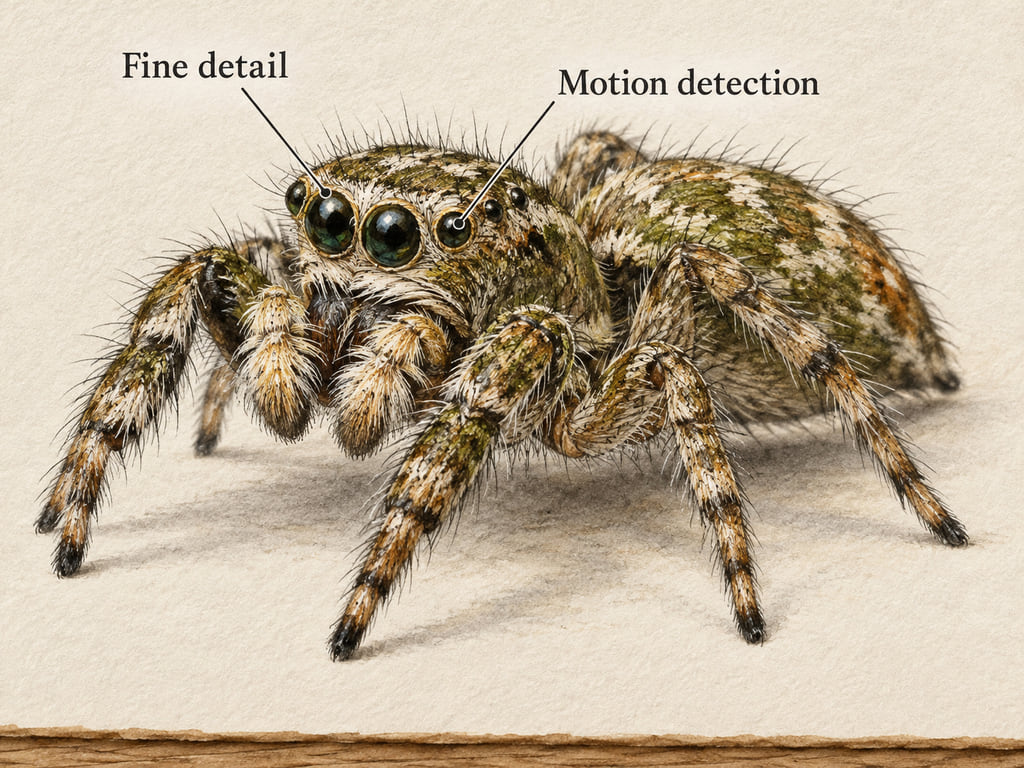
The anterior lateral eyes have a wider field and lower spatial resolution than the principal eyes. One especially clear experiment used Phidippus audax, the bold jumping spider. Researchers presented a black circle that either expanded, suggesting an approaching object, or contracted. They compared responses while different eye pairs were covered.
Spiders with their principal eyes covered still tended to back away from the expanding circle. Covering the anterior lateral eyes reduced that response. Very few spiders backed away from the shrinking circle. The 2012 looming-object study therefore linked a specific defensive response to the lateral pair. It did not show that these eyes identify everything they detect.
That difference matters when interpreting a spider turning toward you. Detecting change and bringing a target into the principal eyes' view can explain an attentive-looking movement. The behavior is interesting on its own; it does not need a claim that the spider understands who you are.
What a jump adds to the picture
A successful leap needs information about distance as well as direction. The Australian Museum's account describes jumping spiders approaching prey and judging a jump before pouncing. That natural behavior raises a testable question: which visual information helps set the distance?
In Hasarius adansoni, researchers found evidence for image defocus: distance information carried by a blurred image. The principal-eye retina has layered photoreceptors. Green-sensitive receptors occupy both a deeper layer, where green light is focused, and another layer that receives a defocused image. The blur is relevant information, rather than simply a flaw to eliminate.
In Nagata and colleagues' 2012 experiment, changing the wavelength of illumination affected depth judgments in a way consistent with that mechanism. This is a species-specific experimental result, not evidence that every spider judges depth like a human using two eyes. Nor does it mean the jump itself creates the visual information: vision helps guide the movement before landing.
What scientists still study
Coordinating eyes involves more than automatically turning toward every new movement. In a 2021 attention study, researchers tracked the principal eyes while introducing a distracting stimulus visible to the anterior lateral eyes. Whether the spider shifted its gaze depended on properties of both the original target and the distractor. The result supports flexible allocation of visual attention under those experimental conditions.
It is a substantial finding, but its question was attention, not recognition of a familiar human. A study that measures where an animal looks answers a different question from one that tests whom it recognizes. A video of a spider facing a keeper cannot by itself separate those possibilities.
Color vision also varies among jumping spiders. The Morehouse Lab's research on Habronattus describes a retinal filter that shifts some green-sensitive receptors toward red sensitivity, providing ultraviolet, green, and red channels in the studied system. The filter occupies a limited retinal area. That example is a reason to name the species or genus, rather than announce that all jumping spiders see the same colors.
Body size and appearance answer different questions from vision; our comparison of scary-looking spiders treats those separately. When reading a new vision claim, look for three things: the species studied, the stimulus presented, and the behavior measured. Those details tell you what the experiment actually explains.
Frequently Asked Questions
How many eyes do jumping spiders have?
Jumping spiders have eight eyes arranged in four pairs. The two large front-center eyes are the principal eyes; the other six are secondary eyes. A front-facing photograph usually makes only four obvious. The remaining pairs sit farther around the head, and the small posterior median pair can be difficult to see.
Can a jumping spider recognize a person?
A spider turning toward you or tracking your movement does not establish recognition of an individual person. Eye-tracking experiments show how spiders direct attention to visual targets, not that they identify a particular human. Demonstrating personal recognition would require a study that distinguishes identity from movement, appearance, and other cues.