
Who Wrote “White Christmas”? Irving Berlin, Bing Crosby, and Two Films

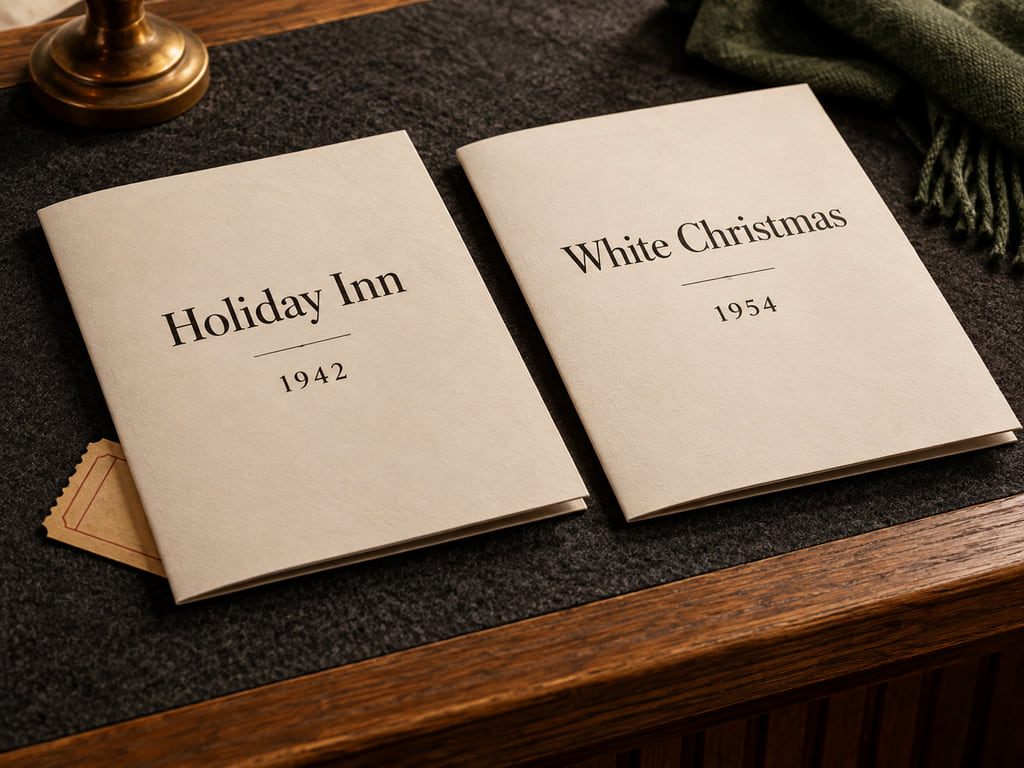
Irving Berlin wrote both the music and the lyrics to “White Christmas.” Bing Crosby sang the famous recording. The song appeared in Holiday Inn in 1942, long before the 1954 movie White Christmas. Those are three connected pieces of history: a song, a singer’s recording, and two films with different titles.
If you remember Crosby singing it beside a snowy inn, the names can easily run together. The quickest way to untangle them is to follow the credits: who wrote the song, who performed it, and which film you are watching. That distinction also explains why a recording date, a movie date, and a songwriting date can all be different without contradicting one another.
Irving Berlin wrote it; Bing Crosby made the famous recording
The clearest authorship credit comes from the Academy’s record of the 1943 Oscars. Under Music (Song), the winner is “White Christmas” from Holiday Inn, with music and lyrics credited to Irving Berlin. Crosby’s association with the song concerns its performance. You can credit his voice without making him its composer.
Notice the two jobs included in Berlin’s credit. Music means the composition; lyrics means the words. Some songs split those jobs between collaborators. Here, the credit gives both to Berlin. If your question is simply who wrote “White Christmas,” his name supplies the answer without a second songwriter.
The award date is useful, too. The ceremony took place on March 4, 1943, honoring films released in 1942. That is why a reference to a 1943 Oscar can sit beside the 1942 film date. Neither date points to the movie released in 1954. The Academy’s entry gives the song title, film, and writer together, making it a convenient place to check all three.
The song before Holiday Inn
The song’s early development is less tidy than its authorship credit. The Library of Congress recording essay dates Berlin’s writing to 1940. Berlin’s own official song history preserves a later newspaper account placing the melody in August 1938. These accounts should not be compressed into one supposedly certain day of composition.
On the official site, Berlin recalled writing it for a proposed revue, putting it away, and later using it in a Crosby picture. That recollection makes the distinction between an initial idea and its later film use especially useful. A song can develop before the production that introduces it to a much wider audience. Avoid treating a vivid hotel-room origin story as an established location.
The subsequent chronology is clearer. The Library of Congress describes Crosby singing it on The Kraft Music Hall on Christmas night in 1941 and recording it on May 29, 1942. The radio performance therefore belongs before the movie’s release. Hearing a song on the radio, making a commercial recording, and seeing it in a film are separate events.
| Date | Event | What it identifies |
|---|---|---|
| 1938 / 1940 | Different composition accounts | The song’s development, rather than one settled date |
| December 25, 1941 | Crosby radio performance | An early public performance |
| May 29, 1942 | Crosby recording session | The original commercial recording |
| 1942 | Holiday Inn | The earlier film featuring the song |
| 1947 | Crosby records it again | A later performance of the same composition |
| 1954 | White Christmas | The later movie sharing the song’s title |
Holiday Inn in 1942 and White Christmas in 1954
The American Film Institute’s entry for Holiday Inn identifies a 1942 musical directed by Mark Sandrich, starring Crosby, Fred Astaire, and Marjorie Reynolds. Its story follows performer Jim Hardy’s attempt to leave show business for a farm, which becomes an inn with holiday entertainment. “White Christmas” belongs to that film’s musical story.
That setting helps explain the confusion: the earlier movie already combines Crosby, an inn, holidays, and Berlin’s music. Seeing those ingredients does not mean you are watching the film called White Christmas. Check the title and cast. Astaire’s presence is a useful clue to Holiday Inn, while the later film has a different central team.
The official history of the 1954 film names Crosby, Danny Kaye, Rosemary Clooney, and Vera-Ellen, with Michael Curtiz directing. Its story pairs two war veterans turned entertainers with a sister act. Alongside the title song, its Berlin score includes “Snow” and “Sisters.” The musical identity connects the pictures even though the performers and story have changed.
AFI’s White Christmas catalog entry says the later picture was advertised as a follow-up to Holiday Inn, but notes that the plots bear little resemblance. Calling it a follow-up does not make the title song a new 1954 composition. The later film gave an existing song another screen setting.
There is another writing credit to keep separate. AFI lists Norman Krasna, Norman Panama, and Melvin Frank as writers of the 1954 movie. That identifies the film’s writing, not authorship of the song. Asking who wrote White Christmas without specifying song or screenplay can therefore produce a different, perfectly relevant set of names.
Why recordings and songwriting credits matter
Crosby recorded “White Christmas” again in 1947. The Library of Congress explains that the original master had worn out and identifies the later recording as the version listeners commonly hear. A playlist’s date can therefore describe a different Crosby performance of Berlin’s composition. A new recording does not mean somebody wrote a new song.
When checking a release, look for the performer and songwriter in separate fields. Then find the recording information, rather than relying only on the date beside an album cover. A compilation can package music from another period. Likewise, a film soundtrack and a studio single should not automatically be treated as the same performance merely because their titles match.
A useful listening note might read: Berlin for songwriting; Crosby for performance; then the recording year, if the release identifies it. Keep an unknown recording year blank rather than filling it with the movie date. This small habit prevents a collection of familiar songs from becoming a collection of mistaken credits.
Where the sales-record question belongs
Authorship and commercial success answer different questions. A songwriter credit tells you who created the music and words. A sales claim needs a defined recording, format, territory, and counting method. Neither the popularity of Crosby’s performance nor a later film’s success changes the name attached to Berlin’s composition.
For that separate comparison, see our guide to best-selling Christmas songs. Keep singles and albums separate when reading record claims: a song title may appear on both without making their totals interchangeable. Here, the useful result is the credit you can carry to a recording or movie listing: identify the work first, then the writer, performer, and version.
Frequently Asked Questions
Did Bing Crosby write White Christmas?
No. Irving Berlin wrote the music and lyrics. Bing Crosby was the singer whose recording became closely associated with the song. A recording credited to Crosby identifies the performer; it does not transfer the songwriting credit to him. The Academy also credits Berlin with both music and lyrics for the song in Holiday Inn.
Was it written for the 1954 movie?
No. The song was already heard in Holiday Inn in 1942, twelve years before the film White Christmas. The later movie used the established song and shared its title. Its screenplay credits describe a different kind of writing: they identify the film’s writers, rather than the composer and lyricist of its title song.