The Biggest Spiders: Leg Span, Body Length, and Mass Compared

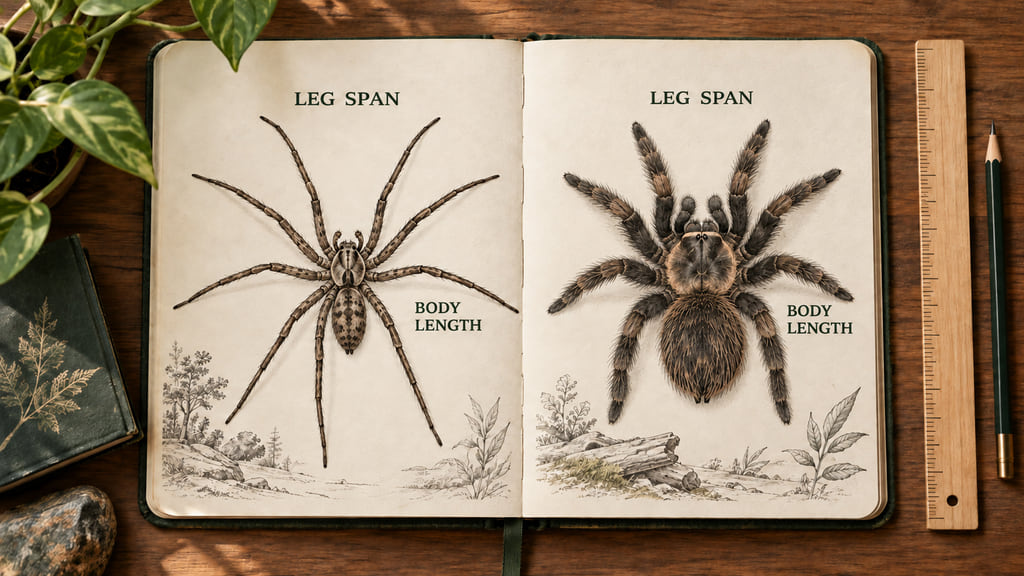
The biggest spider in the world depends on what you measure. The giant huntsman, Heteropoda maxima, is usually cited for its enormous leg span. The goliath birdeater, Theraphosa blondi, is the heavyweight and has the much longer body in this comparison. A spider that covers more ground with its legs does not automatically weigh more.
There is a wrinkle in the familiar two-winner answer: Guinness World Records also notes reports of exceptional goliath birdeaters matching the giant huntsman's roughly 30 cm span. Treat the huntsman as the usual leg-span answer, rather than promising an undisputed lead over every individual ever measured. The comparison below separates dimensions, published ranges, and particular record specimens. Sources were checked on October 21, 2026.
Two different record holders
Think of this as two questions: which spider stretches farthest across a surface, and which carries the most body? Leg span answers the first. Mass answers the second. Body length supplies another useful comparison, especially when the long legs dominate a photograph. None of these measurements can stand in for the other two.
The contenders also belong to different families. The giant huntsman is a huntsman spider in Sparassidae; the goliath birdeater is a tarantula in Theraphosidae. The World Spider Catalog identifies the huntsman species and its published descriptions. Using scientific names keeps a story about one species from quietly becoming a claim about every huntsman or every tarantula.
A fair comparison needs a measurement label beside every number. “Twelve inches” without that label could describe an entire spread of legs, while a much smaller number might describe the whole central body. Read the unit and the endpoints before deciding which animal is larger.
What leg span, body length, and mass measure
Leg span is the reach across the legs, from a foot tip on one side to a foot tip on the other. Posture and the chosen pair of legs affect that distance. A photograph of a tightly crouched spider and one of a fully spread spider are therefore poor measuring tools unless the method and scale are clear.
Body length concerns the two main body regions together: the cephalothorax at the front and the abdomen behind it. It excludes the long walking legs. Taxonomic descriptions may report those regions separately, as prosoma and opisthosoma. A table of individual leg segments is something else again: adding segments of one leg does not give the animal's full tip-to-tip span.
Mass, usually stated in grams, is a weighing, not a distance. An inch figure cannot be converted into grams. Nor can a photograph tell you a reliable mass merely because a spider looks bulky. Keep the categories separate when comparing an exhibit label, a research paper, or a record-book entry.
For unit conversions, 30 cm is approximately 11.8 inches, commonly rounded to 12 inches. That rounding does not create a second, larger record. Likewise, a body measurement given in millimeters needs converting to centimeters before comparison. Converting units fixes the arithmetic; it does not resolve differences in specimens or measuring methods.
Giant huntsman: the leg-span record
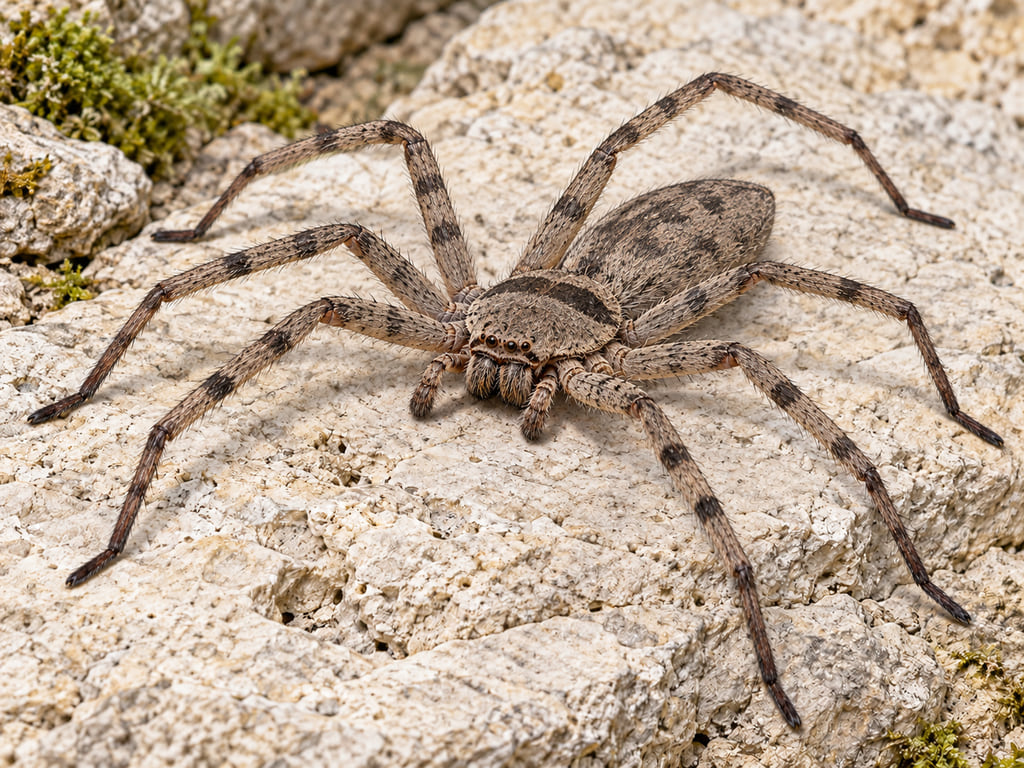
Heteropoda maxima was described by Peter Jäger in 2001 from material collected in Laos. The catalog entry for the original species description establishes that publication's identity; it should not be mistaken for a standardized survey of every living spider. The species' reputation rests on a very wide reach relative to the central body.
For actual body measurements, the 2009 treatment by Steffen Bayer and Peter Jäger gives males at 24.0–30.0 mm and females at 28.5–48.5 mm. The upper female value is 4.85 cm, or about 1.9 inches. These are published specimen ranges, not an average or a promise about every adult.
The same treatment lists measured legs separately and records specimens from limestone caves in Laos. This is why “a 30 cm spider” needs context: the often-cited span belongs to the spread of legs, while the measured body is only a fraction of that distance. Guinness puts the reported male span at up to roughly 30 cm.
Goliath birdeater: the heavier spider
The Smithsonian's National Zoo describes Theraphosa blondi with a body reaching 12 cm, or 4.75 inches, and a leg span reaching 28 cm, or 11 inches. Its rainforest range lies in northern South America. That body-length figure helps explain why the animal earns its reputation even beside a more widely spread huntsman.
For a weighing with clear context, Guinness describes a captive individual assessed in February 1998 at 170 g, roughly 6 ounces, with a span of 28 cm. That is an individual measurement, not the normal weight of the species. It is separate from other maximum figures and exceptional-span reports on the record page.
The name “birdeater” creates a different misconception. The zoo says birds are not frequent meals; its own animals eat cockroaches. A memorable common name tells you little about either a daily menu or a measurement method. Here, the useful distinction is the goliath's substantial body and documented mass, rather than its name's dramatic suggestion.
A comparison you can read without a scare ranking
The numbers below preserve their source context. They are not results from two spiders measured together under identical conditions. In particular, the goliath's body-length maximum and its dated weighing must not be combined into a description of one imaginary specimen.
| Species | Leg span | Body length | Mass |
|---|---|---|---|
| Giant huntsman Heteropoda maxima | Reported up to about 30 cm (12 in); Guinness | Males 24.0–30.0 mm; females 28.5–48.5 mm (up to 1.9 in); Bayer & Jäger, 2009 | — |
| Goliath birdeater Theraphosa blondi | Up to 28 cm (11 in); Smithsonian. Guinness also notes exceptional reports of 30 cm. | Up to 12 cm (4.75 in); Smithsonian | 170 g (6 oz), captive individual assessed February 1998; Guinness |
The dash means the cited huntsman measurements do not supply a comparable weighing. It does not mean zero grams, and it is not an invitation to estimate a weight from a photograph. The wider animal need not be the heavier one.
Size answers a different question from appearance or bite risk. Our comparison of scary-looking spiders keeps those topics separate. For this page, the useful next step is simpler: whenever you see a biggest-spider claim, ask which dimension was measured, whether it describes a maximum or an individual, and whether the source actually measured that quantity.
Frequently Asked Questions
What is the biggest spider by leg span?
The giant huntsman, Heteropoda maxima, is generally cited for a leg span reaching about 30 cm, or 12 inches. That is a maximum span across the legs, not its body length or a typical adult size. Guinness also notes reports of exceptional goliath birdeaters reaching a similar span, so an absolute, uncontested lead needs qualification.
Is the heaviest spider also the widest?
Not necessarily. The goliath birdeater, Theraphosa blondi, is recognized for its mass, while the giant huntsman is known for its leg span. Guinness describes a captive goliath measured at 170 g with a 28 cm span in February 1998. Those measurements belong to that individual; they do not establish the weight of every adult or a universal size ratio.