
Buffet vs. All-You-Can-Eat: What the Two Terms Actually Mean
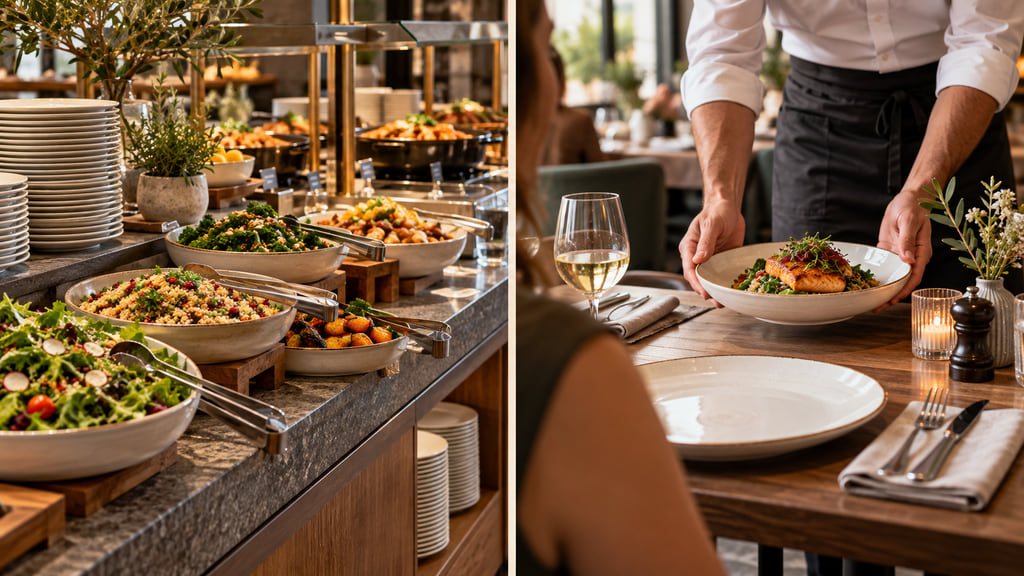
Buffet describes how food is presented and served. All-you-can-eat describes a fixed-price offer of repeat servings. They often appear together, but they answer different questions: Where do I get my food, and what does my payment cover? A restaurant can offer both, one, or neither.
This guide separates service format from pricing so you can read a menu before committing to a meal. The four combinations below are comparison models, not a ranking of restaurants or a promise about every location. U.S. restaurant examples and dictionary definitions were checked October 22, 2026; no sample dollar amounts are needed to explain the distinction.
Service format and quantity promise are different
In the dining sense, Merriam-Webster defines buffet around a meal arranged for accessible, informal service. The important feature is the food presentation. Picture dishes arranged along a counter where you make selections, rather than ordering every course separately from a server. That arrangement does not, by itself, tell you whether another plate costs extra.
Collins describes all-you-can-eat in terms of a fixed payment that does not change with how much you eat. In practice, read that promise alongside the offered menu: which dishes qualify, when the offer applies, and any stated conditions. It is a restaurant pricing arrangement, not a description of where the serving spoon sits.
Self-service and table service are therefore a separate question from repeat portions. A station might have an attendant who serves a particular dish, while another part of the meal comes to your seat. Ask about the actual process if it matters to you. The useful distinction survives these variations: serving format describes the journey of the food; pricing describes the bill.
Four common combinations
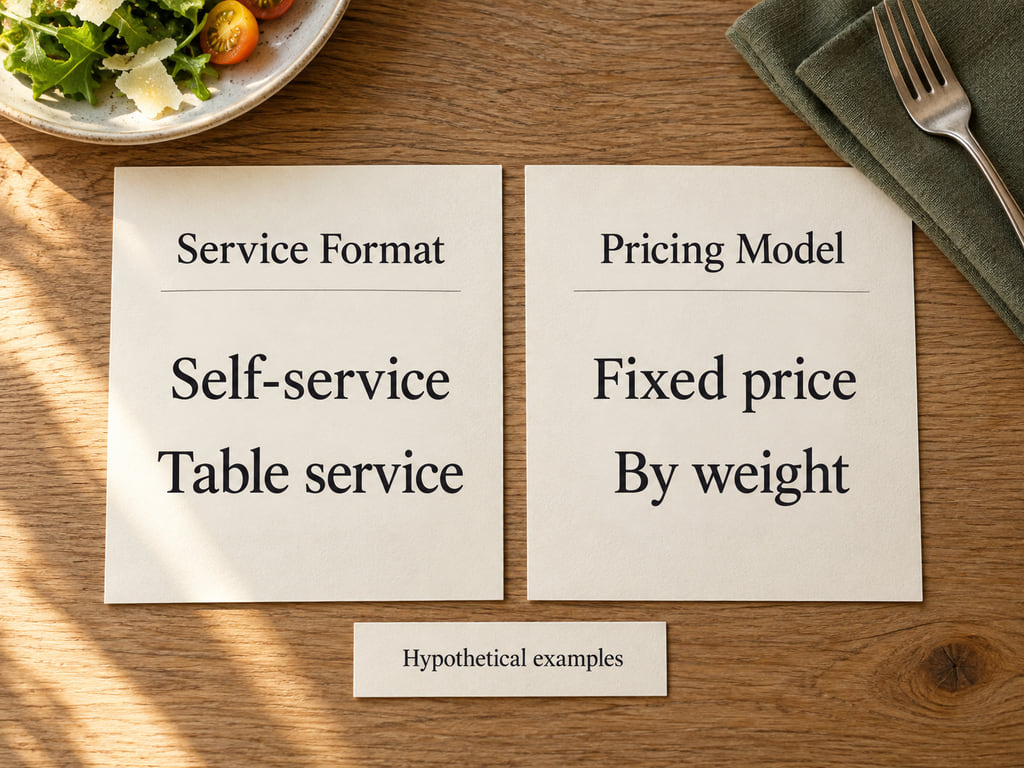
Use the table as a way to decode an offer. The examples are deliberately simplified and hypothetical. They show why the presence of a counter, a server, or a large menu cannot settle what you will owe. No single restaurant is being described as operating all four models.
| Model | How food reaches you | How payment works | Repeat servings? |
|---|---|---|---|
| Fixed-price all-you-can-eat buffet | Select food at stations | One meal price for the included selection | Under the offer's terms |
| Buffet-style counter priced by weight | Select food at a counter | The amount selected affects the charge | Additional food adds to the purchase |
| All-you-can-eat with table service | Servers bring repeat portions | One price for the included menu | Under the offer's terms |
| Ordinary à la carte meal | Order individual menu items | Pay for the items ordered | Additional orders are separately priced unless offered otherwise |
For a real example of the first combination, Golden Corral describes its offering as an endless buffet. That confirms how those concepts can overlap. It does not establish another restaurant's menu, nor does it tell you the current price of a particular meal at your local branch.
For the table-service combination, Fogo de Chão's FAQ describes its Full Churrasco Experience as a fixed-price menu with continual meat service at the table. The same explanation includes a Market Table, so a meal can combine serving formats. You do not need an exclusively self-service room for repeat servings to be part of an offer.
What is included in the price?
Start with the scope of the meal rather than the word unlimited. Check drinks, separately listed premium dishes, dessert, taxes, and any stated service charge before comparing totals. Phrase the question concretely: “Does this meal include the drink I want?” That is easier to resolve than asking whether absolutely everything is included.
Then check the conditions attached to repeat orders. Is there a dining period? Must everyone sharing the table choose the same offer? What happens to uneaten food? Ask rather than importing a rule from a different restaurant. For a documented example, Good Choice Sushi's AYCE menu states that uneaten ordered items are charged at à la carte prices. That is an example of one operator's condition, not a universal rule.
Imagine two hypothetical offers: one includes repeat food servings with drinks ordered separately; the other sells food by weight. At the first, another included serving leaves the food component unchanged. At the second, adding food changes the quantity you buy. Neither description tells you which meal is better for your group without checking appetite, food choices, and the final terms.
Questions to ask before sitting down
A quick conversation can resolve the ambiguity before you choose a table or fill a container. Read the sign or menu first, then use the questions below for anything still unclear. You are checking the specific offer you intend to buy, including the day and meal period.
- How is this meal charged? Establish whether it is a fixed price per diner, a charge by weight, or a bill for individual dishes. If a sign only says buffet, ask the payment question separately.
- What belongs to the included menu? Check the foods and drinks you actually want. A premium item listed elsewhere on the menu should prompt a question before you order it.
- How do repeat servings work? Find out whether you return to a station, reorder through a server, or use another ordering system. Choose manageable portions rather than assuming the next round must be large.
- What conditions affect the visit? Ask about any time limit, group participation, sharing, leftovers, and takeout. Do not assume a dine-in repeat-serving offer includes food to bring home.
- What will the total include? Confirm the applicable meal price and separately charged items. If a child or another diner uses a different menu, ask how that choice changes the group's order.
For someone who wants a small lunch, a separately priced dish might be a better fit than an inclusive meal. For a group that wants variety, a clearly defined repeat-serving offer might be easier to compare. These are choices about the meal you want, not reasons to eat beyond your comfort to justify a ticket.
How this explains buffet-chain stories
Keeping the terms separate also helps when reading about restaurant closures. A buffet is a service format, while all-you-can-eat is a pricing promise; neither label alone explains why a business succeeded or failed. A claim about a chain's finances needs evidence about that company and period.
Our guide to buffet chains that closed locations covers that separate history. Use it for brand and closure context. For choosing dinner, return to the narrower question: which foods and servings does this particular offer include, and how is the bill calculated?
Frequently Asked Questions
Is every buffet all-you-can-eat?
No. Buffet describes a way of presenting and serving food; it does not establish how the bill is calculated. A buffet-style counter priced by weight charges for the food you select, while an all-you-can-eat buffet offers repeat servings for a fixed meal price under its menu terms. Check the posted pricing before filling a plate.
Can all-you-can-eat food be served at the table?
Yes. Repeat servings can come to your table instead of requiring trips to a buffet station. Fogo de Chão describes its Full Churrasco Experience as a fixed-price menu with continual tableside meat service. Read the specific menu for included foods and extras; table service alone does not establish an all-you-can-eat offer.
Sources
Definitions: Merriam-Webster: buffet and Collins: all-you-can-eat. Operator examples: Golden Corral, Fogo de Chão's dining FAQ, and Good Choice Sushi's AYCE menu. Checked October 22, 2026.